
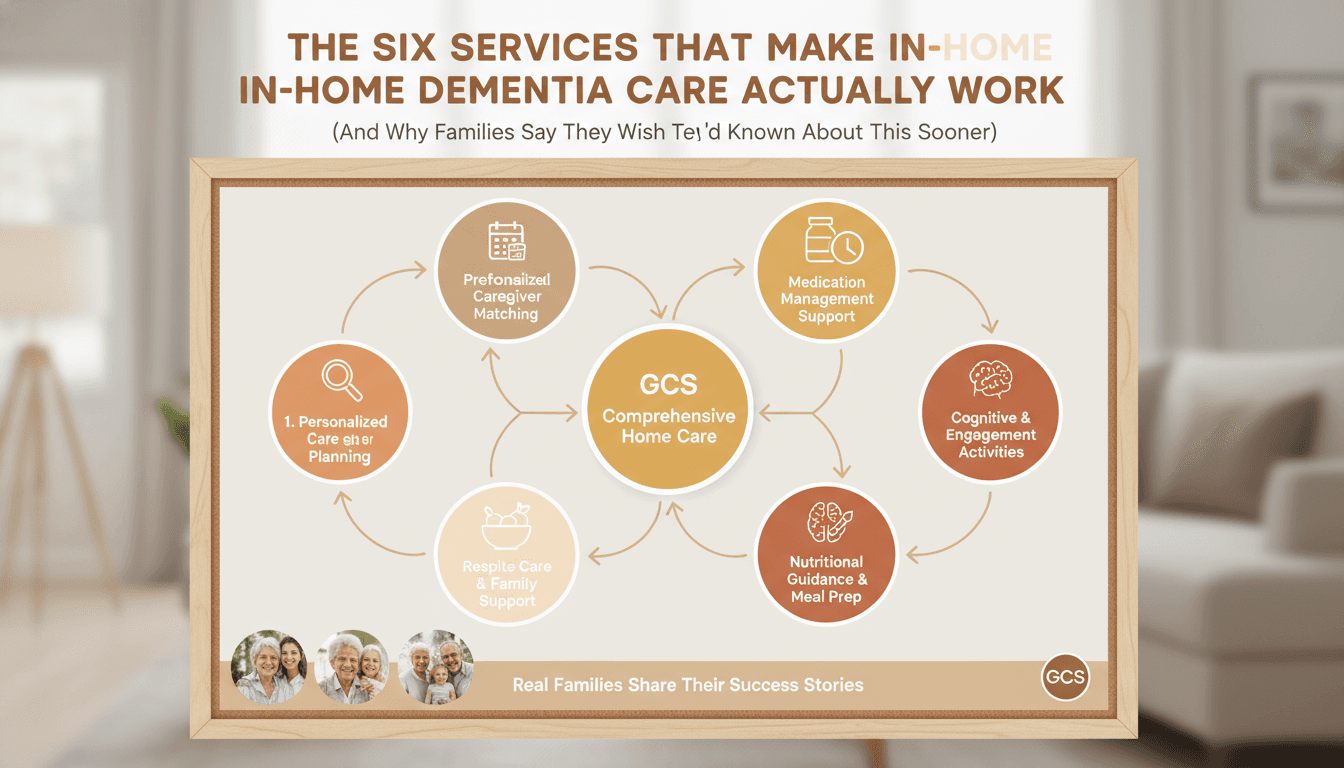
"The Six Services That Make In-Home Dementia Care Actually Work (And Why Families Say They Wish They'd Known About This Sooner)"
"When families first consider in-home care for a parent with dementia, they often imagine someone who helps with daily tasks - bathing, meals, medication reminders. And while those services are important, they're just the beginning. What families discover is that truly successful dementia care requires something much more comprehensive: a coordinated system of specialized services that work together to address not just daily needs, but quality of life, family support, and meaningful connection. Here's what that actually looks like."
If you're researching dementia care options for your parent, you're probably feeling overwhelmed by questions: What kind of help do they actually need? How do you find caregivers who understand dementia? How do you make sure they're not just being "watched" but truly cared for? And how do you, as the family, get the support and guidance you need?
Geriatric Care Solution provides comprehensive dementia care through six specialized services that work together - addressing not just your parent's daily needs, but also behavioral challenges, family education, caregiver training, and long-term planning.
Call 1-888-889-6275 or email ask@gcaresolution.com to discover how our comprehensive approach enables successful dementia care at home.
Why "Just Hiring a Caregiver" Usually Isn't Enough
Let's start with why many families struggle with in-home dementia care:
The standard approach is for families to hire a caregiver (often through a basic agency) to assist with daily tasks. The caregiver assists with personal care, prepares meals, provides companionship.
What often happens:
- The caregiver doesn't understand dementia behaviors and becomes frustrated
- Challenging behaviors escalate because they're not being managed properly
- Family members don't know how to help and feel guilty or overwhelmed
- There's no coordination with doctors or adjustment of the care plan as needs change
- The situation eventually becomes unsustainable
The result: Families feel like "home care didn't work" - when actually, the issue was that the care wasn't comprehensive enough for dementia's complex needs.
Dementia care requires more than assistance with tasks - it requires specialized knowledge, behavioral strategies, family support, and coordinated management.
The Six Services That Make Dementia Care Work
At Geriatric Care Solution, we've found that successful in-home dementia care requires six integrated services working together:
Service #1: Montessori-Based Memory Care (Montessori Care)
What it is: A specialized approach to dementia care based on Montessori principles - focusing on what your parent CAN still do rather than what they've lost, creating meaningful engagement through purposeful activities matched to their remaining abilities.
Why it matters for dementia: Traditional dementia care often treats people as if they're incapable, leading to boredom, depression, and behavioral issues. Montessori-based care maintains dignity and engagement by:
- Identifying preserved abilities and interests
- Creating activities that provide purpose and accomplishment
- Supporting independence in meaningful ways
- Reducing anxiety through structured engagement
- Preventing the decline that comes from inactivity
What this looks like in practice: Instead of just "keeping your mom occupied," we might:
- Create folding tasks for someone who was a meticulous homemaker
- Engage a former gardener in plant care activities
- Support a retired teacher in organizing or sorting meaningful items
- Help someone who loved cooking participate in meal preparation at their ability level
What families tell us: "I was amazed to see my dad engaged and purposeful again. The caregiver found ways for him to contribute that I never would have thought of. He's not just being watched - he's living."
Service #2: Therapeutic Touch and Emotional Connection (Caring Touch)
What it is: Specialized training in using gentle, appropriate touch to provide comfort, reduce anxiety, and maintain human connection as verbal communication becomes more difficult.
Why it matters for dementia: As dementia progresses, your parent may struggle to understand words or express themselves verbally. But they still need comfort, reassurance, and connection. Therapeutic touch provides:
- Anxiety and agitation reduction
- Comfort during confusing moments
- Connection when words don't work anymore
- Pain relief and physical comfort
- Emotional security and reassurance
What this looks like in practice: Our caregivers are trained to:
- Use gentle hand massage during moments of distress
- Provide comforting shoulder touch during transitions
- Recognize when touch is welcome vs. when it might increase agitation
- Understand cultural sensitivities around physical contact
- Combine touch with calm verbal reassurance
What families tell us: "When Mom gets anxious and confused, the caregiver knows exactly how to calm her with gentle touch and a soothing voice. It's not just physical care - it's emotional care too."
Service #3: Nutrition and Hydration Management (Always Fresh)
What it is: Specialized meal planning, preparation, and feeding assistance that addresses the unique nutritional challenges of dementia - from forgetting to eat, to swallowing difficulties, to behavioral issues around mealtimes.
Why it matters for dementia: Many people with dementia lose significant weight, become dehydrated, or develop malnutrition - not because food isn't available, but because:
- They forget they need to eat or that they haven't eaten
- They struggle with coordination needed for eating
- Swallowing becomes difficult and unsafe
- Appetite changes or food aversions develop
- Mealtimes become confusing or overwhelming
What this looks like in practice: We address dementia-specific eating challenges:
- Preparing foods that are easy to eat and swallow safely
- Creating routines around mealtimes for predictability
- Adapting textures and presentation as needs change
- Gently encouraging and assisting without pressure
- Monitoring hydration throughout the day
- Adapting strategies as swallowing abilities decline
What families tell us: "Dad had lost so much weight before we brought in professional help. The caregiver figured out exactly what he would eat, how to present it, and how to gently encourage him to eat. He's gained back healthy weight and mealtimes are pleasant again."
Service #4: Medical Care Coordination (Healing Ally)
What it is: Professional coordination between your parents' various healthcare providers, medication management, symptom monitoring, and communication with the family about medical changes.
Why it matters for dementia: Managing dementia involves coordinating multiple medications, tracking symptoms, communicating with neurologists and primary care physicians, and recognizing when something has changed that requires medical attention. This becomes impossible for families to manage alone, especially when they are far away.
What this looks like in practice:
- Ensuring medications are taken correctly (critical for dementia management)
- Tracking behavioral changes that might indicate medication issues
- Communicating with doctors about what's actually happening day-to-day
- Attending medical appointments and providing accurate information
- Recognizing early signs of infections or other health issues
- Coordinating between multiple specialists
What families tell us: "Living across the country, I had no idea if Mom was taking her medications correctly or if her symptoms were changing. Now I get regular updates, and the care coordinator communicates with her neurologist. I finally have peace of mind."
Service #5: End-of-Life Planning and Support (Care Bliss)
What it is: Compassionate support for families navigating end-of-life decisions, advance care planning, hospice coordination, and ensuring your parent's final chapter is peaceful and dignified.
Why it matters for dementia: End-of-life planning is especially important with dementia because your parent may lose the ability to communicate their wishes. Having these conversations early, and having support as the disease progresses, ensures their preferences are honored.
What this looks like in practice:
- Facilitating conversations about end-of-life wishes while your parent can still participate
- Helping families understand dementia's progression and what to expect
- Coordinating with hospice when appropriate
- Supporting families through difficult decisions
- Ensuring dignity and comfort in final stages
- Providing bereavement support for families
What families tell us: "Having these conversations early was hard, but so important. When the time came, we knew exactly what Mom wanted. The support we received made it possible for her to die peacefully at home, surrounded by family."
Service #6: Family Education and Caregiver Training (Care Mentor)
What it is: Comprehensive training and ongoing education for both professional caregivers and family members about dementia progression, behavioral management, communication strategies, and self-care.
Why it matters for dementia: Dementia is constantly changing. What works today might not work next month. Families need education about what to expect, how to communicate effectively, and how to manage challenging behaviors. Professional caregivers need specialized training beyond basic personal care.
What this looks like in practice:
For families:
- Understanding different stages of dementia and what to expect
- Learning communication strategies that reduce frustration
- Recognizing triggers for behavioral issues
- Managing your own stress and guilt
- Knowing when and how to make difficult decisions
- Connecting with other families going through similar experiences
For professional caregivers:
- Specialized dementia behavior management training
- Understanding different types of dementia and their unique challenges
- De-escalation techniques for agitation or aggression
- Activity engagement strategies
- Recognizing medical vs. behavioral issues
- Continuous education as the disease progresses
What families tell us: "The education we received changed everything. We finally understood why Dad was doing certain things and how to respond. It reduced everyone's stress and helped us connect with him in ways we thought we'd lost."
How the Six Services Work Together: A Real Family Story
Let me show you what comprehensive dementia care looks like when all six services work together:
The Thompson Family: From Crisis to Connection
The situation: Margaret's mother, Dorothy (78, moderate Alzheimer's), was living alone with daily visits from a basic home care aide. The family was struggling:
- Dorothy was losing weight and seemed depressed
- Behavioral issues were escalating (anxiety, agitation, wandering attempts)
- The caregiver was frustrated and threatening to quit
- Margaret (living two hours away) was constantly worried and exhausted
- Nobody knew how to manage Dorothy's increasing confusion and distress
The assessment: When Margaret contacted Geriatric Care Solution, we conducted a comprehensive evaluation and identified the gaps:
- No specialized dementia training for the current caregiver
- No meaningful engagement or activities matched to Dorothy's abilities
- Medication management issues (Dorothy was forgetting doses)
- No coordination with her neurologist
- No support or education for the family
- No plan for disease progression
The comprehensive solution: We implemented all six services working together:
Montessori Care: Assessment revealed Dorothy was a former librarian who loved organizing. We created meaningful sorting and organizing activities that gave her purpose and reduced her anxiety.
Caring Touch: Trained caregivers in therapeutic touch to comfort Dorothy during moments of confusion without increasing agitation.
Always Fresh: Addressed Dorothy's weight loss through routine mealtimes, foods she enjoyed from her past, and gentle assistance that maintained her dignity.
Healing Ally: Coordinated with her neurologist, adjusted medication timing, tracked behavioral patterns, and identified a UTI that was worsening her confusion.
Care Bliss: Facilitated conversations with Dorothy (while she could still participate) about her wishes for future care, giving the family peace of mind.
Care Mentor: Educated Margaret and her siblings about Alzheimer's progression, communication strategies, and what to expect - reducing their anxiety and improving family visits.
The outcome after six months:
- Dorothy gained back healthy weight and seemed more content
- Behavioral issues decreased significantly with proper engagement and management
- The family felt supported and educated rather than lost and guilty
- Dorothy's medical issues were caught early and managed properly
- Everyone had peace of mind about the future
Margaret's reflection: "I didn't know comprehensive care like this existed. I thought we just needed someone to help Mom with daily tasks. What we got was a complete support system - not just for Mom, but for our whole family. She's thriving at home in ways I didn't think were possible."
Why This Approach Works When Basic Care Doesn't
The difference between basic care and comprehensive care:
Basic home care provides:
- Personal care assistance (bathing, dressing)
- Meal preparation
- Light housekeeping
- Companionship
- Medication reminders
This can work fine for someone with physical limitations but good cognition.
Comprehensive dementia care provides:
- Everything above, PLUS:
- Specialized dementia behavioral management
- Meaningful engagement matched to abilities
- Therapeutic techniques for comfort and connection
- Medical coordination and symptom tracking
- Family education and support
- Long-term planning and guidance
- Trained caregivers who understand dementia
This is what's required for dementia's complex and changing needs.
When Does Your Parent Need Comprehensive Dementia Care?
You might benefit from comprehensive services if:
- Your parent's behaviors are becoming challenging (anxiety, agitation, confusion)
- Basic caregivers seem frustrated or don't know how to engage your parent
- Your parent seems depressed, withdrawn, or just "existing" rather than living
- You're struggling to coordinate medical care from a distance
- Family members don't know how to communicate or help
- You're worried about the future and don't know what to plan for
- Current care feels like it's not really addressing dementia's unique needs
You don't need to wait for crisis - comprehensive care works best when started early, preventing many of the crises that otherwise become inevitable.
What Happens When You Contact Geriatric Care Solution
Here's exactly what to expect:
Step 1: Comprehensive assessment (no cost) We evaluate:
- Your parent's current stage of dementia and specific challenges
- What's working and what's not in current care
- Family dynamics and support needs
- Which of the six services would benefit your situation
- Cost structure for comprehensive care
Step 2: Customized care plan Not every family needs all six services immediately. We create a plan that:
- Addresses your most pressing challenges first
- Adds services as needs evolve
- Fits your budget and family situation
- Can scale up or down as dementia progresses
Step 3: Caregiver selection and training
- We match caregivers with specialized dementia training
- Provide additional training specific to your parent's needs
- Ensure they understand and can implement all six service elements
- Create backup plans for consistency of care
Step 4: Ongoing coordination and adjustment Dementia changes - your care needs to adapt:
- Regular reassessment and care plan updates
- Family meetings to address concerns and questions
- Continuous caregiver education
- Medical coordination with healthcare providers
- Crisis support when needed
You'll walk away knowing:
- Your parent has comprehensive support for all aspects of dementia care
- You have education and resources to help effectively
- There's a plan for the future as needs change
- You're not alone in this journey
The Investment in Comprehensive Dementia Care
Comprehensive care costs more than basic care - but families consistently tell us the value far exceeds the cost:
What you're paying for:
- Specialized dementia expertise (not just personal care)
- Six coordinated services working together
- Continuous education and adjustment
- Peace of mind that needs are truly being met
- Prevention of crises that would be far more expensive
- Quality of life for your parent and your family
Payment options:
- Private pay with flexible scheduling
- Long-term care insurance (many policies cover comprehensive services)
- Veterans Aid & Attendance benefits
- Combination approaches to make care sustainable
Many families tell us: "I wish we'd started comprehensive care earlier. The difference in Mom's quality of life - and our peace of mind - is worth every penny."
Ready to Learn More About Comprehensive Dementia Care?
If you're realizing that basic care isn't addressing your parent's dementia needs - or if you want to start with comprehensive support from the beginning - we can help.
Geriatric Care Solution's six-service approach provides:
- ✅ Montessori-based memory care for meaningful engagement
- ✅ Therapeutic touch for comfort and connection
- ✅ Specialized nutrition support
- ✅ Medical care coordination
- ✅ End-of-life planning and support
- ✅ Family education and caregiver training
All working together to make dementia care at home successful.
Contact Geriatric Care Solution: Call: 1-888-889-6275 Email: ask@gcaresolution.com
Let's talk about your parent's specific needs and how our comprehensive approach could help. Free assessment, no pressure - just honest guidance about what would work best for your family.
Successful in-home dementia care requires more than assistance with daily tasks - it requires specialized knowledge, behavioral strategies, meaningful engagement, family support, and coordinated management. When these six services work together, families discover that their loved ones can thrive at home in ways they didn't think possible.